Business groups warn of trade and hiring impact as dispute with India continues

Open this photo in gallery:

People protest outside the Indian Consulate in Vancouver on Sept. 25.DARRYL DYCK/The Canadian Press

Companies operating in Canada and India are taking a hit as the diplomatic dispute between the two countries stretches into its second month, according to business groups.

Relations between Canada and India were thrown into turmoil in September when Prime Minister Justin Trudeau alleged that India’s government was responsible for the killing of Hardeep Singh Nijjar, a Canadian citizen who advocated for an independent homeland for Sikhs.

In advance of the accusations becoming public, Ottawa cancelled a trade mission and suspended trade talks, which business groups had expected would at least produce an interim free-trade deal by the end of the year.

With no end in sight, and continued escalation – such as Canada pulling out dozens of diplomats on Thursday – community leaders say businesses are in a heightened state of uncertainty.

“Business wants clarity, stability and predictability, and those three things have not been there,” said Victor Thomas, president of the Canada India Business Council. “In many ways, we’re still trying to figure out how we navigate this new period of time.”

India has had a huge role in Canada’s economy through its diaspora, with 1.3 million Canadians reporting their ethnic origin as Indian in the 2021 census.

The trading relationship, though, has been disproportionately smaller. India is Canada’s eighth-largest trading partner, with $5.6-billion in exports in the last year, a fraction of what Canada sends to the U.S. or China. The majority of exports are from resource extraction or agriculture.

Businesses had hoped a trade deal might turn that around. In May, the two countries released a joint statement saying they hoped an initial trade deal might be signed by the end of this year, and lead to expanded investments in areas such as clean technology.

But relations turned frosty after Mr. Nijjar’s death in the summer, and the trade talks were officially postponed in September.

“It’s a very big shock and setback for the business community because this kind of episode creates a lot of uncertainty about what’s going to happen next,” said Satish Thakkar, chair of the Canada India Foundation.

Businesses have been careful about expressing concerns publicly during the tense diplomatic environment, but groups say they are hearing growing worries from their members.

Of particular concern is India’s suspension of visa services, said Matthew

Read more

People, housing, land: N.W.T. business leaders call for cascade of change from next gov’t

The outlook was rather grim.

“The recovery from the pandemic returns the economy to its pre-pandemic path of slow decline,” read this year’s budget documents for the Northwest Territories.

The budget goes on to list a raft of challenges: inflation, high interest rates, a shortage of workers, insufficient economic diversification, and the fast-approaching closure of the territory’s three diamond mines.

This summer’s devastating wildfires and evacuations haven’t helped the situation.

Now, candidates in the N.W.T. general election are out canvassing, and business leaders are expressing their concerns and offering ideas for how to invigorate the territory’s wilting economy.

Land development difficulties

Right now, getting land from the territorial government in Yellowknife ‘is like pulling teeth out of your face,’ said Rob Warburton, a Yellowknife developer and city councillor. (Submitted by Rob Warburton)

“Fundamentally, if you want to grow the economy, you need to grow your population,” said Rob Warburton, a Yellowknife developer and city councillor. 

Specifically, the territory needs more skilled workers, he said, but a lack of housing across the N.W.T. is a big barrier to bringing them in.

“All the focus of government is consistently about social housing and the housing corporation, which needs a lot of attention, but there’s no conversation around the private sector, which actually provides most of your housing in Yellowknife, Hay River,” he said. 

“I’d love to hear some candidates talk about how do we support economic growth in partnership with industry, because that’s who actually builds your housing, that’s who employs a lot of people.”

One thing the territorial government could do to spur housing development is make more land available to communities, he said. Right now, he said, the process for getting that land in Yellowknife is akin to “pulling teeth out of your face.”

Adrian Bell, a realtor and president of the Yellowknife Chamber of Commerce, agrees that growing the population and addressing the labour shortage are key to economic growth — and that more housing is necessary to achieve those things. 

“I hear this all the time of people who’ve accepted jobs and they come to town to try to find housing and they can’t, and they have to turn the job down and they leave,” he said. 

A headshot of Yellowknife realtor Adrian Bell.
‘I hear this all the time of people who’ve accepted jobs and they come to town to try to find housing and they can’t, and they have to turn the job
Read more

Why Business Leaders Should View Artificial Intelligence As A Co-Pilot

Darren Person is the Chief Digital Officer at Circana. He leads the company’s new digital initiatives that combine marketing and technology.

Across industries, people have been voicing worries about artificial intelligence replacing jobs. These worries aren’t unfounded: A report published by the Pew Research Center in July 2023 indicated that in 2022, “19% of American workers were in jobs that are the most exposed to AI, in which the most important activities may be either replaced or assisted by AI.” What’s more, a June 2023 report by outplacement firm Challenger, Gray & Christmas found that in May 2023, 3,900 jobs were cut due to AI. On the flip side, some companies have restricted or banned the use of AI in their workplaces.

Business leaders shouldn’t approach AI from these two extremes. They shouldn’t consider AI as a direct replacement for jobs, nor should they back away from it. Instead, they should shift their mindsets and view this technology as a co-pilot.

An ‘Us Versus Them’ Mentality Will Get Companies Nowhere

The reality is that AI is here to stay, and companies that want to be innovative will need to leverage it smartly. The companies that don’t lean into it risk falling behind their competitors eventually. Consider some of the other market disruptions we’ve seen and the companies that failed because they didn’t get ahead of those disruptions. A prominent example? Video rental stores. As one bankruptcy case study noted, Giants Movie Gallery and Blockbuster “began struggling to compete with streaming and mailing platforms,” and both were “driven into bankruptcy because they failed to adapt quickly enough.”

Business leaders should not approach AI with an “us versus them” mentality. As the saying goes, “If you can’t beat them, join them.” Think about this: When your industry is being disrupted, who better to take the helm than you?

Replacing Jobs With AI Is Not The Answer

However, some business leaders have jumped to the other extreme, using AI to replace employees. Companies are generally trying to reduce costs and grow simultaneously. With AI in the mix, there’s arguably greater tension between these two goals—executives might be inclined to view AI as a quick cost-saving measure. But this, in my view, is not the answer in many cases. Over-reliance on AI could hinder or dismantle critical business functions.

A research paper published in June 2023 gives valuable insights into

Read more

Today’s news: Trending business stories for October 23, 2023

The latest business news as it happens

Article content

Today’s top headlines

Article content


1:21 p.m.

Report calls for national water management plan for Canada’s agri-food sector

Advertisement 2

Article content

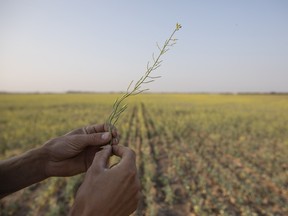
A farmer holds a canola plant that has been stricken by drought on a grain farm near Osler, Sask., 2021.
A farmer holds a canola plant that has been stricken by drought on a grain farm near Osler, Sask., 2021. Photo by Kayle Neis/Bloomberg files

The Canadian Agri-Food Policy Institute is recommending that governments across the country develop a national plan to sustainably manage and use water for the agri-food sector.

In a report released Monday, the institute called for ambitious commitments from governments and partnerships with stakeholders to prioritize the critical natural resource.

“Water is a strategic asset for Canada, and an increasingly critical and important one,” said Tyler McCann, CAPI managing director and

Read more

A Ugandan business turns banana fiber into sustainable handicrafts

MUKONO, Uganda (AP) — A decapitated banana plant is almost useless, an inconvenience to the farmer who must then uproot it and lay its dismembered parts as mulch.

But can such stems somehow be returned to life? Yes, according to a Ugandan company that’s buying banana stems in a business that turns fiber into attractive handicrafts.

The idea is innovative as well as sustainable in the East African country. Uganda has the highest banana consumption rate in the world and is Africa’s top producer of the crop. Especially in rural areas, bananas can contribute up to 25% of the daily calorie intake, according to figures from the U.N. Food and Agriculture Organization.

In Uganda, eating bananas is in many ways embedded in local customs and tradition; for many a meal is incomplete without a serving of matooke, the local word for the starchy boiled mush made from banana cultivars harvested and cooked raw.

To harvest the crop, the stem must be decapitated, and in the largest plantations the scene can seem violent after a bumper harvest. The stems inevitably rot in open fields.

But local startup TEXFAD, which describes itself as a waste management group, is now taking advantage of this abundance of rotting stems to extract banana fiber that’s turned into items that would include hair extensions for women.

John Baptist Okello, TEXFAD’s business manager, told The Associated Press that the business made sense in a country where farmers “are struggling a lot” with millions of tons of banana-related waste. The company, which collaborates with seven different farmers’ groups in western Uganda, pays $2.70 for a kilogram (more than two pounds) of dried fiber.

David Bangirana, the leader of one such group in the western Ugandan district of Sheema, said only a small part of the inner stem of a decapitated plant is harvested for fiber. And the “residue is returned after machine work to the farmer for use as manure,” he said.

His group is working to build capacity to make finished products, he said.

TEXFAD also takes material from a third party, Tupande Holdings Ltd., whose trucks deliver banana stems from farmers in central Uganda. Tupande’s workers sort through the stems, looking for desirable ones. Machines then turn the fiber into tiny threads.

Aggrey Muganga, the team leader at Tupande Holdings Ltd., said his company deals with more than 60 farmers who continuously supply abundant raw material.

Read more