Canadian Soccer Business, Mediapro trade accusations in court filings

TORONTO — The opening blows have been delivered in a court battle that could have major implications for how Canadian soccer fans view the domestic brand of the beautiful game.

On one side is Canadian Soccer Business, whose investor group and board includes the Canadian Premier League owners. CSB looks after marketing and broadcast rights for both the CPL, which is entering his sixth season, and Canada Soccer.

On the other is Mediapro, CSB’s Barcelona-based media partner — a global entity that produces content for 16 soccer leagues worldwide.

Both sides want out of the 10-year agreement struck in 2019, saying the other failed to live up to the deal. And both want the other to pay for it.

None of their claims have been proven yet, with the ball now in the Ontario Superior Court of Justice. But CSB says it has taken back its rights from Mediapro and is looking for other broadcast partners.

In a five-page notice of action, CSB alleges Mediapro has reneged on its payments and “improperly repudiated” their agreement covering media rights and production, broadcast and distribution.

In a 32-page statement of claim, Mediapro alleges CSB has not lived up to its promises, saying that halfway through the agreement CSB has delivered just over a quarter of the number of required matches (a guaranteed minimum of 2,042 CPL and Canadian Championship games by 2028).

Mediapro also says the league had promised to expand to 10 teams by 2020 and 16 teams by 2024.

“The league has remained stagnant at eight teams since 2020 and shows signs of decline rather than growth,” the statement of claim says.

“Mediapro has delivered on its bargain. CSB has materially failed to do so and provides no reasonable prospect of doing so within the agreed upon term,” it adds.

Mediapro wants damages of at least $50 million, court costs and a declaration that it was within its right to terminate the deal.

“No entity has invested more in Canadian soccer than Mediapro,” it says in its statement of claim.

“Currently, Mediapro’s investment into Canadian soccer exceeds $60 million which is a combination of capital expenditures, operation and production costs and licence fees,” it added.

In its filing, Canadian Soccer Business alleges Mediapro did not meet its requirements, including failing to deliver on a sub-licensing arrangement for linear television broadcasting that would expose its content to a greater audience via


Read more

N.B. coffee shop raising autism awareness celebrates 5 years in business – New Brunswick

Aaron Nielsen had his son in mind when opened the first  Aaron’s Coffee House five years ago at a New Brunswick farmer’s market.

Makhi, 16, lives with autism and sensory processing disorder, a condition his father calls “a daily battle.” Nielsen said he and his wife wanted to open a coffee shop in order to build a safe space for Makhi to interact with others as well as create opportunities for people with similar conditions.

Aaron’s started as a pop-up coffee shop at the Salisbury farmer’s market and has since grown to include a location in Riverview as well as one in downtown Moncton.

“If anything happens to my wife and I, this is going to take care of (Makhi) financially,” Nielsen said. “And then we thought well, if we’re gonna do this for him we gotta do this for other people, too. That’s where we got the idea to hire and train other people like my son.”

Story continues below advertisement

Both Aaron’s locations operate out of rooms within Queen E vape shop locations.


Get the latest National news.

Sent to your email, every day.

Nielsen calls the partnership “a great opportunity,” but the shared space presents challenges for his plans to hire employees with autism. So he’s looking to expand on his own.

“We’re contacting investors, we’re trying to get to the point where we can have our own stand-alone location,” he said.

Makhi isn’t able to work in the coffeehouse just yet, as he doesn’t feel high temperatures due to his sensory issues, which could create a safety issue, Nielsen said.

For now, Makhi makes magnets that are sold at Aaron’s and helps out where he can.

“If I need some extra cups from out back, if I need some extra milk, if there’s anything that I need, he’ll grab that for me,” Nielsen said. “Sometimes he’ll try to interact with customers but at the same time we’re not pushing him.”

Customer Brenda Richard said she appreciates the social inclusion aspect of the café.

“It’s good for community support and it helps a lot of families. I think it’s a wonderful idea,” she said.

Story continues below advertisement

Employee Matthew Murphy is currently in his first year of studies at the

Read more

Corporate London teams up with Nokee Kwe to help meet economic reconciliation goals

London business owners looking to hire and diversify their workforce are being encouraged to consider Indigenous employees as an act of reconciliation that organizers say will also be good for the bottom line. 

A new program, led by the non-profit employment skills centre Nokee Kwe and supported by the London Chamber of Commerce, hopes to address two issues identified by employers: staff shortages and cultural representation in the workplace.

“Let’s not just envision an inclusive workplace, let’s become that change,” said Sharon Deebrah, the project manager for the First Employ Project for Business Reconciliation. “Collaborating and networking is the key to economic development.”  

The corporate sector was called upon in the Truth and Reconciliation Commission to actively engage in reconciliation practices, including ensuring Indigenous peoples have equitable access to employment and training.

“Sadly, businesses across the country have not stepped up to their moral obligation under the TRC regulations,” said Graham Henderson, CEO of the London Chamber of Commerce.

“We were dismayed to see from a recent study that 31 per cent of businesses do not think that the calls to action applies to them. They thought it was only personal.”

Henderson said of the steps toward reconciliation that have been taken, including land acknowledgements and sharing educational resources, economic reconciliation remains a missing piece.

He hopes by connecting Chamber of Commerce members and others in corporate London to Nokee Kwe’s project, business leaders in London will have an easier time hiring and supporting Indigenous employees.

“Folks want to do this. They just don’t really understand how to do this,” Henderson said. 

The first order of business for the First Employ Project for Business Reconciliation is to conduct a survey with employers to understand where they’re at and what they want to know. After that, the data will be used to create recruitment and retention materials. 

“I’m very optimistic about this. This is a changing culture and people are far more open to learning after learning the details of the residential schools. People are interested in opening their doors to our community,” Deebrah said. 

She said more information for getting involved will be coming soon. 

LISTEN: Nokee Kwe organizers and the CEO of the Chamber of Commerce explain the goals

London Morning10:14How can businesses attract and retain Indigenous talent?

The Nokee Kwe London Employment and Education Centre is launching a new project to help local businesses attract and

Read more

These Business Strategies Are Blowing Up The Indoor Pickleball Club Market

We’re deep into the pickleball craze in the United States, with participation numbers continuing to swell and demand rising for courts nationwide. At the same time, we’re seeing opportunistic operators take over abandoned shopping malls and move into spaces once occupied by big-box stores that are falling on hard times.

One of the biggest names in the pickleball-goes-to-the-mall trend is none other than the Major League Pickleball founder Steve Kuhn, with his appropriately named “Pickle mall” concept; he’s already making nationwide plans for construction. But Kuhn is by no means the only player in the market, and we’ve already seen dozens of indoor facilities open around the country.

As more indoor facilities stake their claim, the industry is seeing a wide variety of approaches to the construction, configuration, and operations of these facilities. I spoke to a number of indoor facility operators around the country and found a wide variety of approaches, with each business bringing unique characteristics to the table.

Over the past couple of months, I had the opportunity to speak representatives from these indoor pickleball companies:

  • GameChangers in southwest Chicagoland
  • Dill Dinkers, a Washington, D.C. area chain now franchising nationally with more than 120 signed affiliates
  • Pickle Haus in Algonquin, Illinois in the Chicago northern suburbs.
  • Pickleball Kingdom, the largest existing franchisor of pickleball clubs
  • Dan Jenkins, a Pickleball Kingdom – North Texas franchisee building an indoor facility in Plano, with others planned
  • Performance Pickleball RVA (aka PPBRVA), which opened in January in Richmond, Virginia’s West End
  • Chicken N Pickle, the famous restaurant and pickleball chain with locations from Indiana to Las Vegas
  • The Picklr, the Utah based chain that’s now franchising nationally and making a huge splash
  • Pickleballerz, an indoor facility in Chantilly, Virginia that was in operation pre-Covid, well before the pickleball boom started
  • Bangers & Dinks, an indoor facility in Richmond, Virginia’s Midlothian suburb
  • Crush Yard, a fantastic space now open in Mount Pleasant, S.C., part of the greater Charleston area
  • Ace Pickleball Club, a franchise model that has just opened its first two locations in Roswell, Georgia and Fort Wayne, Indiana
  • Pickle and Social, which just opened a massive space in Gwinnett, Georgia.

Their experiences and approaches are sprinkled throughout

Read more

Over four million illegal vapes seized at border

By Ben KingBusiness reporter

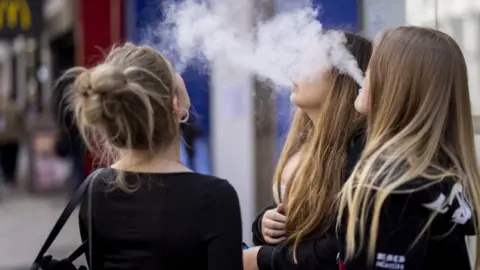
Rex/Shutterstock A group of young girls vapingRex/Shutterstock

The number of illegal vapes seized at the border quadrupled last year as UK authorities wrestle with unlicensed imports amid a surge in youth vaping.

More than 4.5m vapes weighing nearly ten tonnes were seized over the last 12 months, four times more than 2022.

The figures were released to the BBC after a Freedom of Information (FOI) request.

The government is soon to announce new rules for the industry, including a possible ban on disposable vapes.

The single-use products have surged in popularity since the pandemic. With bright packaging and flavours named after sweets and soft drinks, there have been calls to restrict their marketing to protect children. It is illegal to sell them to under-18s.

Disposable e-cigarettes have strict limits on their nicotine levels in the UK – just 2ml of liquid with 20mg of nicotine per millilitre provide around 500-600 puffs of vapour.

A collection of non-compliant vapes
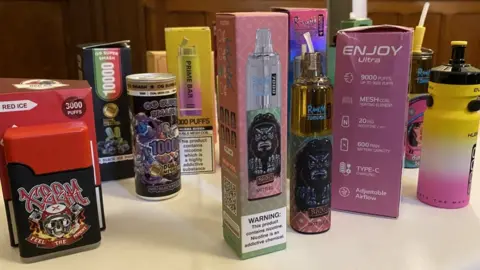
A collection of non-compliant and counterfeit vapes, displayed in Parliament by the Independent British Vape Trade Association

However, Chinese-made vapes which contain much larger amounts of liquid and promise thousands of puffs are widely available in the UK.

On London’s Oxford Street, illegal disposable vapes offering 3,500 puffs are openly on sale. BBC News was also easily able to buy two vapes containing 4.5ml of liquid from two UK-based online retailers.

“They’re out there in broad daylight, in plain view. It is scary how prevalent they are,” said Dan Marchant of the online retailer Vape Club. “People are getting away with it. They are acting with complete impunity.”

Thousand-fold increase

Figures released to the BBC in response to an FOI request show that Border Force seized just 4,430 vapes in 2021, rising to 988,064 in 2022, and 4,537,689 from January to October 2023.

Unlike legal vapes, illegal e-cigarettes are not registered with the Medicines and Healthcare Products Regulatory Agency and do not pass through quality control processes so may contain harmful chemicals.

And retailers prepared to flout product rules may not be scrupulous about observing the ban on selling to under-18s.

A Home Office spokesperson said the government would “not tolerate the sale of illegal products and… harmful goods, such as illegal or counterfeit vapes”.

“Border Force work closely with law enforcement partners to share intelligence and have a strong track record in targeting illicit commodities,” they added.

Northamptonshire Police Seized itemsNorthamptonshire Police
A haul of illegal vapes seized last year
Read more